The Direct Report’s Playbook: Owning Your 1:1
How engineers, designers, and team members can overcome meeting anxiety, drive the agenda, and accelerate their career.
Why This Meeting Matters
This Meeting Belongs to You: Your manager has sprint plannings, team standups, and architecture reviews to discuss company deliverables. This 30–45 minute slot is the only recurring meeting on the calendar dedicated entirely to your needs, your challenges, and your career trajectory.
What a 1:1 is NOT: It is not a performance interrogation, not a ticket status report, and not a trap. Acknowledging that a project is difficult or that you feel overwhelmed is an act of professional maturity, not weakness.
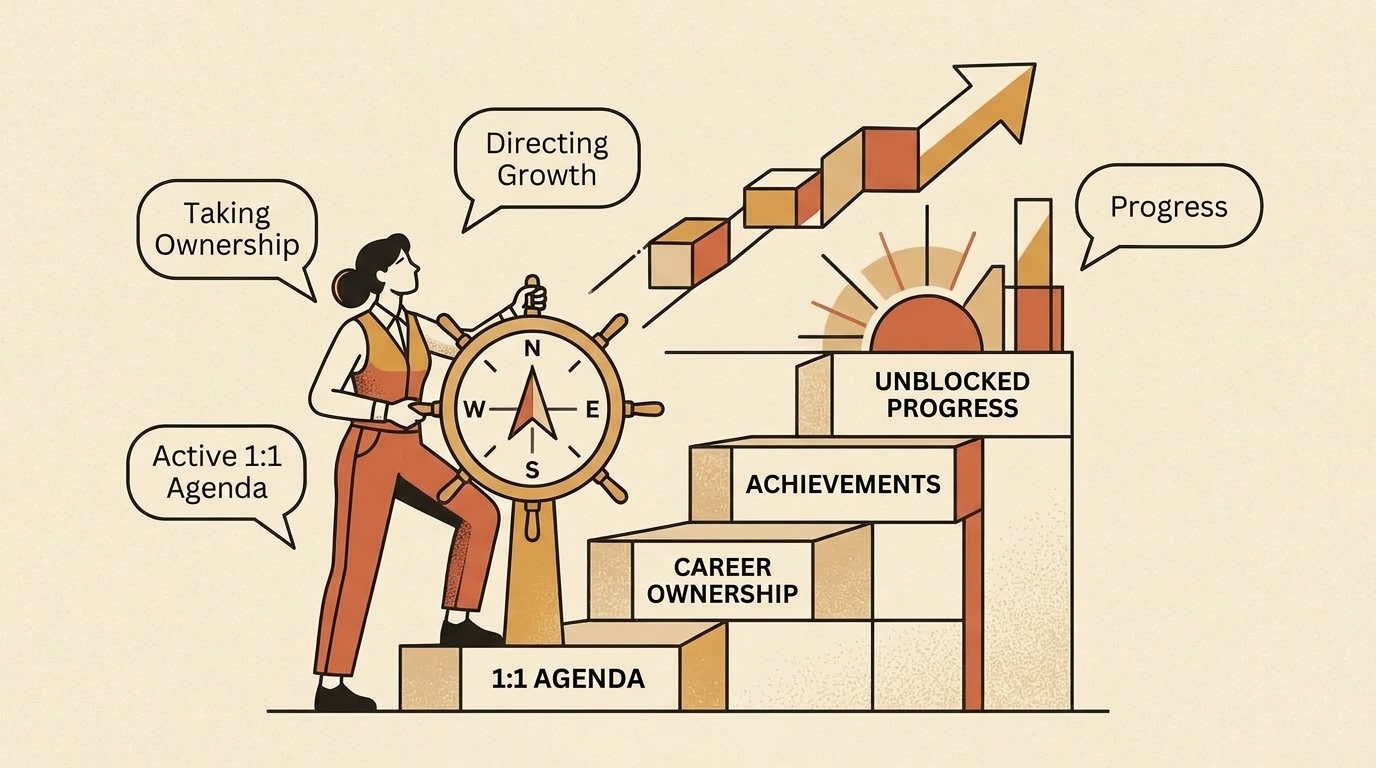
What a 1:1 IS: It is your personal unblocking engine, your career steering wheel, and your primary defense against creeping burnout.
The Cost of Silence: Managers cannot read minds. If you silently work 12-hour days to compensate for broken CI or unclear specs, leadership assumes everything is fine and adds more work. Speaking up proactively protects your focus and longevity.
Before the Meeting: Preparation & Invitation
Step 1: Continuous Logging Between Meetings: Don’t panic 5 minutes before the meeting trying to remember two weeks of work. Use encrypted1on1 throughout your sprint:
• Growth: Learned a tricky debugging technique or read an insightful RFC? Click "Add entry".
• Achievements: Shipped a feature, resolved a thorny bug, or helped onboard a colleague? Log it immediately.
• Discuss: Note questions and topics as they occur during the week.
Step 2: The 5-Minute Pre-Meeting Polish (24h Before):
1. Select Mood and tag emotional feelings (anxious, overwhelmed, motivated, calm).
2. Rate your Workload (Too much, Just right, Too little).
3. Complete "What’s harder than it should be" (Friction)—name slow builds, missing credentials, or cross-team delays.
4. Click Publish so your manager has time to review and prepare support.
5. Use Private Notes for private reminders strictly invisible to your lead and admins.
Recommended Agenda & Questions
Pillar 1: Battery Level & Workload Reality (5 min)
Signal your current capacity, stress level, and emotional trend.
- My workload is currently feeling heavy / sustainable / light—here is how the pace is affecting my deep work.
- I flagged these feeling tags in the anketa: here is the context behind them.
Pillar 2: Friction & Unblocking: Problem + Impact + Proposal (15 min)
Frame obstacles constructively using the Problem–Impact–Proposal model.
- Problem: Our staging environment was unstable 3 times this sprint during release testing.
- Impact: It delayed QA validation and created stress for the entire frontend team.
- Proposal: Can we allocate 2 days next sprint to automate staging deployment? I need your help prioritizing this with Product.
Pillar 3: Career Direction & Competency Leveling (15 min)
Discuss growth, skills, and promotion criteria without awkwardness.
- I want to understand the gap between my current output and Senior Engineer expectations—can we review the rubric together?
- My goal for this year is stepping into technical architecture: which upcoming initiative would be an ideal stretch assignment?
- What is one area of technical or leadership craft you think I should focus on polishing next?
Pillar 4: Mutual Agreements & Outcome Logging (10 min)
Capture concrete action items for both you and your manager.
- Can we log these 2 specific action items under Meeting Outcomes?
- Manager action: Follow up with Platform lead regarding CI test runner capacity.
- My action: Draft the technical proposal for database connection pooling by Friday.
Common Anti-Patterns to Avoid
The Silent Sufferer (Suffering in Silence)
Hiding overwork or confusion leads directly to chronic exhaustion, bugs, and eventual resignation without giving your manager a chance to help.
Say clearly: "My workload is currently unsustainable. Can we review my commitments and decide what to drop, delay, or delegate?"
The 5-Minute Pre-Meeting Scramble
Rushing to fill out notes right before the call results in superficial status updates and missed opportunities for real unblocking.
Log achievements and friction notes incrementally as they happen during the sprint using the open cycle in encrypted1on1.
Vague Venting without Impact or Solutions
Complaining that "everything is broken" without concrete examples leaves managers powerless to advocate on your behalf.
Use the Problem + Impact + Proposal formula: name the issue, demonstrate team impact, and offer a viable solution.
The Ambush Salary Demand
Demanding an immediate 20% raise on the spot puts managers in a defensive corner and rarely succeeds.
De-couple compensation from emotional ultimatums: anchor talks in objective leveling rubrics, skill milestones, and planned review cycles.
After the Meeting: Follow-up & Momentum
1. Check Off Outcomes As You Go: Over the next two weeks, mark completed action items directly in your open Anketa. You own your items; your manager owns theirs.
2. Export Your Period Brag Sheet: When bi-annual or annual performance review season arrives, open the Report view in encrypted1on1. Decrypt your verified log of achievements, growth discoveries, and completed goals over the past 6 months into a structured Markdown document. You will never have to reconstruct your accomplishments from memory again.
Key Guidance for Managers
- Always use the Problem + Impact + Proposal formula when bringing up team or tooling friction.
- Adopt the Feedback Receiver Protocol: breathe, listen for understanding without defending, say thank you, and ask for partnership.
- Use the encrypted Private Notes panel for draft thoughts, salary milestones, or personal reflection.
- Remember: asking for help and setting boundaries is a hallmark of senior engineering maturity.
Core Principle
The 1:1 is your meeting. When you take the steering wheel—logging your wins, naming friction, and asking for sponsorship—you take full control of your engineering trajectory.