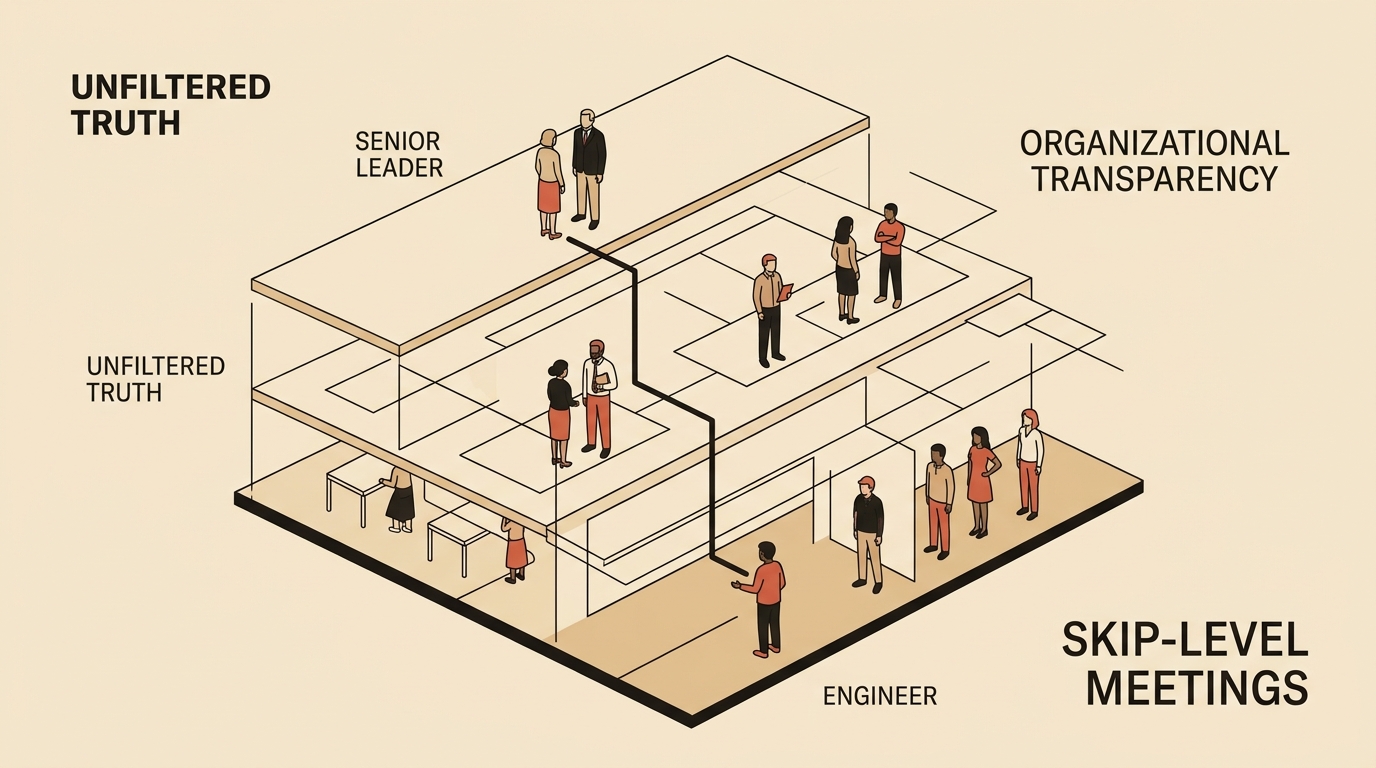
Skip-Level 1:1: Unfiltered Organizational Diagnostics
A high-leverage strategic dialogue between executive leadership (VP/CTO/Director) and frontline engineers: validating strategic signal, removing systemic friction, and calibrating culture.
Why This Meeting Matters
The "Signal Degradation across Hops" Problem: In scaling engineering organizations, bad news is inevitably polished as it travels upward. Middle managers subconsciously soften edge cases in executive summaries to convey that "everything is under control." As a result, executive leadership discovers architectural dead-ends, senior talent flight, or CI test degradation only when a major release slips or production outages spike. Skip-levels deliver unvarnished, first-hand situational reality.
Empowering, Not Undermining, Frontline Leads: The most catastrophic failure mode of a skip-level is degrading into a clandestine audit of the direct manager. If an engineer suspects executive leadership is "digging up dirt on their team lead," psychological safety instantly evaporates. Astute executives frame the session as an audit of the system, tooling, and organizational boundaries, not personalities: "My job is to remove systemic impediments that your manager cannot resolve in isolation."
Cross-Functional Silos & Friction: Frontline engineers are the first to encounter cross-boundary breakdown: multi-day Platform approvals, conflicting Product specs, or compliance bureaucracy. At the team sprint level, these look like minor nuisances; across an entire enterprise, they squander millions in developer velocity.
Strategic Coherence & Retention: For an engineer, a skip-level is an exceptional venue to ask probing questions directly to the authors of company strategy and trace how their individual pull requests impact commercial survival. This is one of the most effective retention levers for Senior and Staff talent.
Before the Meeting: Preparation & Invitation
1. Align with the Frontline Engineering Manager First: Never schedule skip-levels behind a manager's back. Brief them proactively to dispel territorial anxiety: "I'm conducting regular skip-levels across your engineers this quarter. The focus is organizational tooling and strategic clarity, not auditing your management. Let me know if there are specific systemic themes you'd like me to probe."
2. Send a De-stigmatizing Invitation 5 Days Ahead: Individual contributors often feel sudden panic upon receiving a calendar invitation from a CTO or VP ("Am I being fired?" or "Did I break production?"). Preempt this anxiety explicitly:
"Hi! This is our regular quarterly skip-level sync. To be completely explicit upfront: this is neither a performance review nor an audit of your tickets. I want to hear your candid perspective: what's working well, where our tooling or processes are grinding, whether our strategic vision makes sense on the ground, and how executive leadership can unblock your team. No preparation needed—just grab a coffee and let's talk openly."
3. Review Objective Operational Context (5 minutes pre-call): Look up which core services the engineer owns, recent major incident post-mortems they were involved in, and their tenure at the company.
Recommended Agenda & Questions
Block 1: Psychological De-escalation & Context Setting (5–7 min)
Establish high psychological safety and crystal-clear boundary framing.
- Thank you for making time! Just to reiterate: my role today is 80% listening. We aren't reviewing ticket velocity or finding culprits. How are things going with you personally, and how has your week been?
- What part of your day-to-day engineering work right now brings you the most genuine flow, and what generates the most frustration?
- Do you feel you have the tooling, autonomy, and environment required to do the best technical work of your career here?
Block 2: Strategic Coherence & Product Ground Truth (12 min)
Verify whether high-level executive direction translates into sensible ground-level decisions.
- How clear and compelling does our annual technical and business roadmap feel to you? If a new hire asked you, how would you articulate our primary objective?
- What is something leadership frequently repeats during company All-Hands that feels detached from everyday engineering realities?
- Do you have full clarity on how the architectural decisions in your current services tie directly to customer outcomes and business value?
Block 3: Systemic Bottlenecks, Tooling & Cross-Team Friction (15 min)
Uncover deep institutional impediments that require executive intervention.
- What part of our engineering infrastructure (CI/CD pipeline latency, flaky test suites, dev environments, technical debt) steals the most time and energy from your team?
- How does collaboration feel when you need dependencies from adjacent teams (Platform, Security, Data, Infrastructure): where do you run into brick walls or multi-day queues?
- If you stepped into my shoes as CTO for one week with complete authority, what single organizational rule or architectural constraint would you change immediately?
Block 4: Synthesis & Executive Accountability (8 min)
Distill findings, reaffirm confidentiality, and lock in actionable executive commitments.
- Out of everything we unpacked today, what is the single highest-priority impediment at the organizational level holding your team back?
- Is there an important topic I haven't asked you about today that executive leadership urgently needs to understand?
- Agreed: I will personally take ownership of this tooling blocker and report back to you within a week with a concrete update.
Common Anti-Patterns to Avoid
Degenerating into a covert investigation of the team lead ("How is your manager treating you?")
Puts the engineer in an agonizing position of betrayal or drives them into defensive silence. Breeds suspicion and political paranoia across the organization.
Focus strictly on systems, architecture, and inter-team workflows. If the employee initiates complaints about their lead, redirect constructively: "Have you surfaced this candidly in your 1:1s with them?"
Making operational commitments "over the head" of the frontline lead
Overruling technical roadmaps or reassigning tickets during a skip-level destroys the direct manager's operational authority and breeds confusion.
Never make direct operational commitments without the frontline manager. Note the concern and address it with the lead separately: "Your engineer raised a systemic issue—let's collaborate on how to solve it."
The "Feedback Black Hole": soliciting raw critiques and taking zero visible action
When engineers bravely surface systemic issues (e.g., broken test environments) and nothing changes by next quarter, they conclude leadership does not care and speaking up is futile.
Take on no more than 1–2 systemic items, but deliver measurable progress. Even communicating "we investigated and cannot fund this rewrite this quarter due to X" builds credibility.
Deploying skip-levels as an emergency measure only during crises
If an executive only requests a 1:1 when a project is burning down or attrition spikes, it is perceived as an intimidating punitive audit.
Establish skip-levels as a recurring, predictable hygiene cadence during periods of calm execution.
After the Meeting: Follow-up & Momentum
1. Pattern Extraction within 24 hours: Document raw insights in private executive notes. Cross-reference across multiple skip-levels: when 3 engineers across distinct teams flag the identical bottleneck (e.g., waiting 6 days for Security review), you have uncovered an institutional failure.
2. Alignment with Frontline Leads within 48 hours: Discuss systemic insights with the team manager without compromising direct quotes or putting them on trial: "There is strong appetite in the team for CI optimization. Let's look at allocating dedicated platform bandwidth to support your developers."
3. Close the Loop with the Engineer within 7 days: Send a brief personal message closing the loop: "Hey! Following up on our chat regarding staging cluster latency: we've dedicated two infrastructure engineers to revamp pipeline runners. Thank you for speaking candidly!"
Key Guidance for Managers
- Listen 80% of the time, speak 20%: your executive mission on skip-levels is absorbing ground reality, not lecturing on strategy.
- Hunt for patterns, not isolated complaints: a single critique might be personal opinion; three congruent critiques constitute a systemic diagnosis.
- Praise uncomfortable truths: when an engineer challenges leadership assumptions, thank them sincerely—it sets the tone for engineering culture.
- Never promise the impossible: be transparent about business trade-offs when requests cannot be prioritized immediately.
Core Principle
Skip-levels are not about policing managers; they are about clarifying executive vision and removing organizational friction. A resilient culture flourishes when leaders listen directly to the engineers whose hands build the future.