The First 1:1: Setting Expectations & Psychological Safety
Establish mutual trust, calibrate individual work styles (the "Personal User Manual"), and align on transparent ground rules for all future syncs.
Why This Meeting Matters
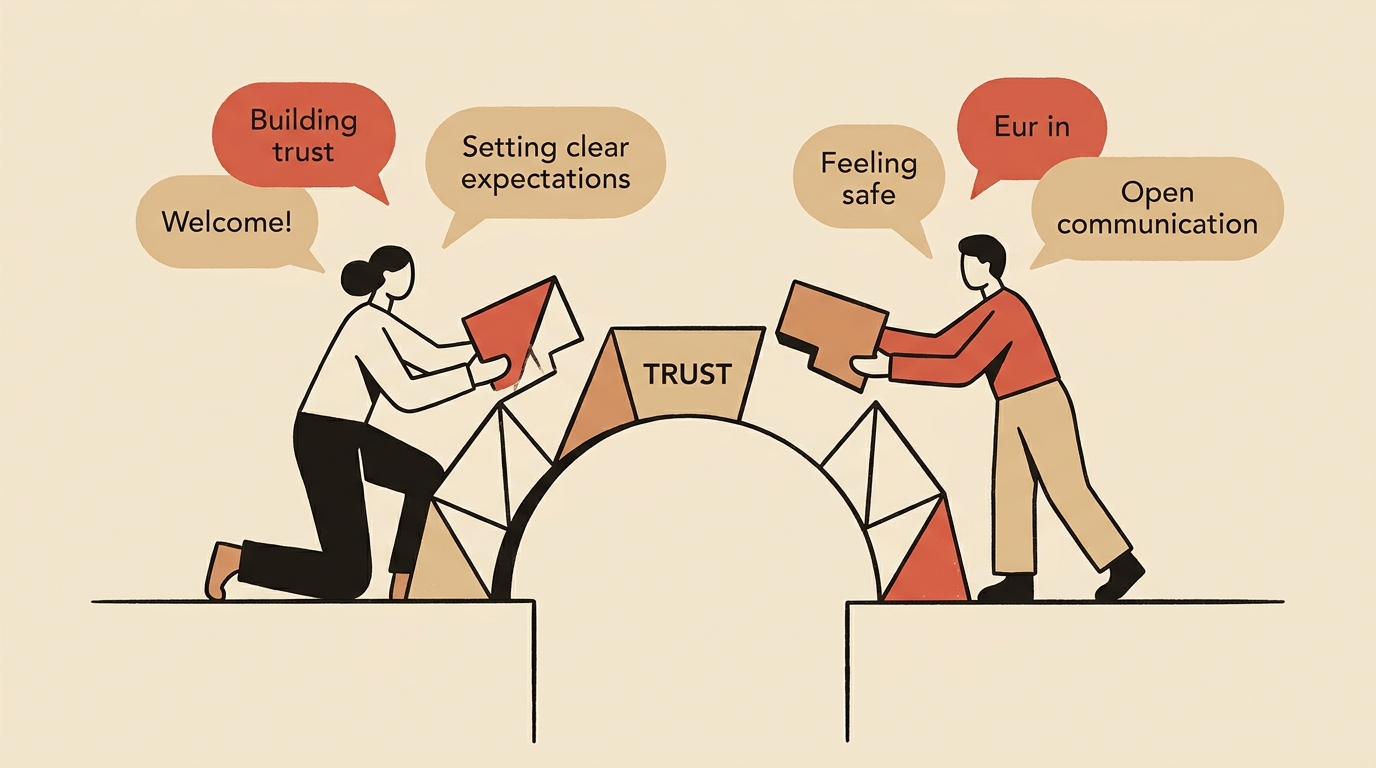
Power Asymmetry and Instinctive Threat Scans: When a new employee or an existing team member receives a calendar invite for their first 1:1 with a manager, their primal cognitive response is threat evaluation. In unfamiliar territory, humans scan for danger: "Did I do something wrong? Will I be interrogated? What do they expect from me?". If the meeting starts without explicit framing, the employee expends their cognitive budget on self-defense rather than genuine dialogue. The primary objective of the first 1:1 is to demystify the format and build psychological safety.
Andy Grove’s Principle — The Employee’s Meeting: In High Output Management, Andy Grove established a timeless axiom: the one-on-one belongs fundamentally to the employee, not the supervisor. The direct report dictates the conversational vector; the manager serves as facilitator, listener, and obstacle remover. Ben Horowitz echoed this in The Hard Thing About Hard Things: if employees do not trust that their leadership genuinely cares about their friction, the organization quietly decays from suppressed problems.
The High Cost of Implicit Expectations: Up to 80% of onboarding friction and misunderstandings stem not from technical deficits, but from unaligned unwritten rules. A manager might assume blockers are flagged instantly in Slack, while an engineer might spend three days quietly stuck, afraid of looking incompetent. The first 1:1 transforms implicit assumptions into explicit agreements.
The "Personal User Manual": Every high-performing contributor operates with a distinct mental interface: some require deep uninterrupted focus mornings, others prefer written critique before meetings, and some need macro organizational context to feel grounded. Calibrating this user manual in week one eliminates months of friction and guesswork.
Before the Meeting: Preparation & Invitation
1. Send an invite with transparent framing: Never send a blank calendar invite titled simply "1-on-1" or "Quick Sync" without context. This universally spikes anxiety. Use this battle-tested invite copy:
"Hi! This is our first recurring 1:1. The purpose of this conversation is to get to know each other, establish how our recurring syncs will work, calibrate how we can best communicate and exchange feedback, and answer any questions on your mind. There will be zero Jira status checks, surprise pop quizzes, or task interrogations. This is your time. If there are topics you already want to bring up, feel free to add them directly to our agenda!"
2. Complete manager prep (15 minutes before the call):
- Review interview notes and background: Revisit their resume and interview feedback. What specifically motivated them to join (system architecture, scale, culture)? What growth areas did the hiring panel observe?
- Verify onboarding hygiene: Ensure essential tool permissions (Git repositories, CI/CD, cloud environments, team channels) are provisioned and that an onboarding buddy is active.
- Ensure total environmental privacy: Hold this meeting behind closed doors in a private conference room or on an individual remote link. Never conduct a first 1:1 in a noisy open cafeteria or open-plan desk where teammates can overhear.
Recommended Agenda & Questions
Part 1: The 1:1 Working Agreement & Safety (10 min)
Establish the meeting philosophy, the 80/20 listening rule, and protective scheduling policies.
- What was your experience with 1:1s in previous companies? What worked well and what felt like a frustrating waste of time? (Listen for: past experiences with micromanagement, last-minute cancellations, or interrogations — this reveals their core anxieties).
- My primary philosophy: this 1:1 is your time, not my status checkpoint. You set the agenda; my job is to unblock you and support your growth. How does that sound to you?
- Let’s set our rescheduling pact: this slot is protected in both our calendars. If an emergency arises, we never cancel into a void — we immediately reschedule for a specific new time that same week.
Part 2: Work Style & The "Personal User Manual" (25 min)
Map out optimal working conditions, focus routines, feedback preferences, and stress indicators.
- What conditions allow you to do your highest-leverage work? Do you require dedicated deep work blocks without meetings or Slack pings? (Listen for: how to shield their calendar from meeting fragmentation).
- How do you prefer receiving developmental feedback: immediately in private chat, in structured writing before a sync so you have time to process, or face-to-face during 1:1s?
- When you are under extreme stress or feeling overwhelmed, how does that usually show up from the outside (going quiet, defensive code reviews, working late)? How can I best support you in those moments?
- What form of appreciation and recognition feels most genuine to you: public shoutouts during demos/channels, or a private 1:1 message highlighting the technical craft of what you built?
Part 3: "Fresh Eyes" Audit & Early Unblocking (15 min)
Capture the invaluable perspective of an unconditioned newcomer before company habituation sets in.
- What has felt most confusing, counterintuitive, or friction-heavy in our codebase, architecture, or team processes so far? (Listen for: documentation gaps, onboarding friction, and technical debt that long-tenured engineers have learned to ignore).
- Do you have all the access, context, and tooling you need right now? Do you have full clarity on what success looks like in your first 30 and 90 days?
- Who on the team or across adjacent teams do you feel you need to connect with next? Would an intro from me be helpful?
Common Anti-Patterns to Avoid
Devolving into a verbal Jira sprint board status update
Destroys the strategic value of the 1:1 and positions the manager as a task auditor. The direct report stops bringing real systemic friction, burnout signals, and interpersonal blockers to the table.
Track project progress asynchronously in your issue tracker or standup. Reserve the 1:1 exclusively for root-cause obstacles, work environment, and team dynamics.
Manager monologue (supervisor talks >50–70% of the duration)
Transforms a safe reflective sanctuary into an exhausting executive lecture. The manager broadcasts their opinions instead of diagnosing subtle team friction.
Apply the 80/20 rule: the direct report speaks 80% of the time. Embrace 5–7 seconds of silence after asking a question — people share their most vulnerable insights right after the pause.
Making premature, unvetted promises regarding compensation or promotion
In an effort to win early approval, managers sometimes make unchecked commitments ("we will promote you in 6 months", "a raise is coming"). If company bands or HR block it, credibility is permanently destroyed.
Articulate transparent engineering rubrics, evaluation cycles, and expectations. Promise dedicated mentorship and honest feedback, but never promise speculative administrative outcomes.
Recording the conversation or storing notes in public company wikis
A blinking red recording icon or an unencrypted Google Doc triggers instant corporate self-censorship. Nobody shares vulnerable interpersonal friction when it can be audited by third parties.
Never record 1:1 conversations. Keep collaborative, end-to-end encrypted notes accessible exclusively to the two participants, focusing only on action items.
After the Meeting: Follow-up & Momentum
1. Deliver a Quick Win within 24 Hours: Identify at least one small friction point mentioned during the conversation (missing repository permission, noisy hardware, software license, or intro to an architect) and resolve it within 24 hours. This is the single highest-signal action you can take: it demonstrates immediately that 1:1s have real operational leverage and that your commitments are reliable.
2. Document Bilateral Commitments Privately: Send or record a crisp 2-to-3 item summary of who owns what before the next sync in an end-to-end encrypted, private space. Avoid general company wikis where sensitive personal calibration might be exposed.
3. Protect the Recurring Rhythm: Verify that a recurring calendar invite (weekly or bi-weekly) is locked into both calendars. Treat this time as sacrosanct — never let ad-hoc status calls displace it.
Key Guidance for Managers
- 80/20 Rule: speak no more than 20% of the time. Master the art of comfortable, attentive silence.
- Protect the slot: if an emergency occurs, reschedule immediately within the same week rather than canceling.
- Zero status queries: check Jira and standups for task status; use 1:1s to understand people, context, and blockers.
- Deliver a 24h Quick Win: unblock one tangible pain point right after the meeting to establish trust in your leadership.
Core Principle
The first 1:1 builds the psychological foundation for the entire working relationship. A direct report’s speed of integration and openness over the next six months depends on whether they felt heard and safe in this conversation.