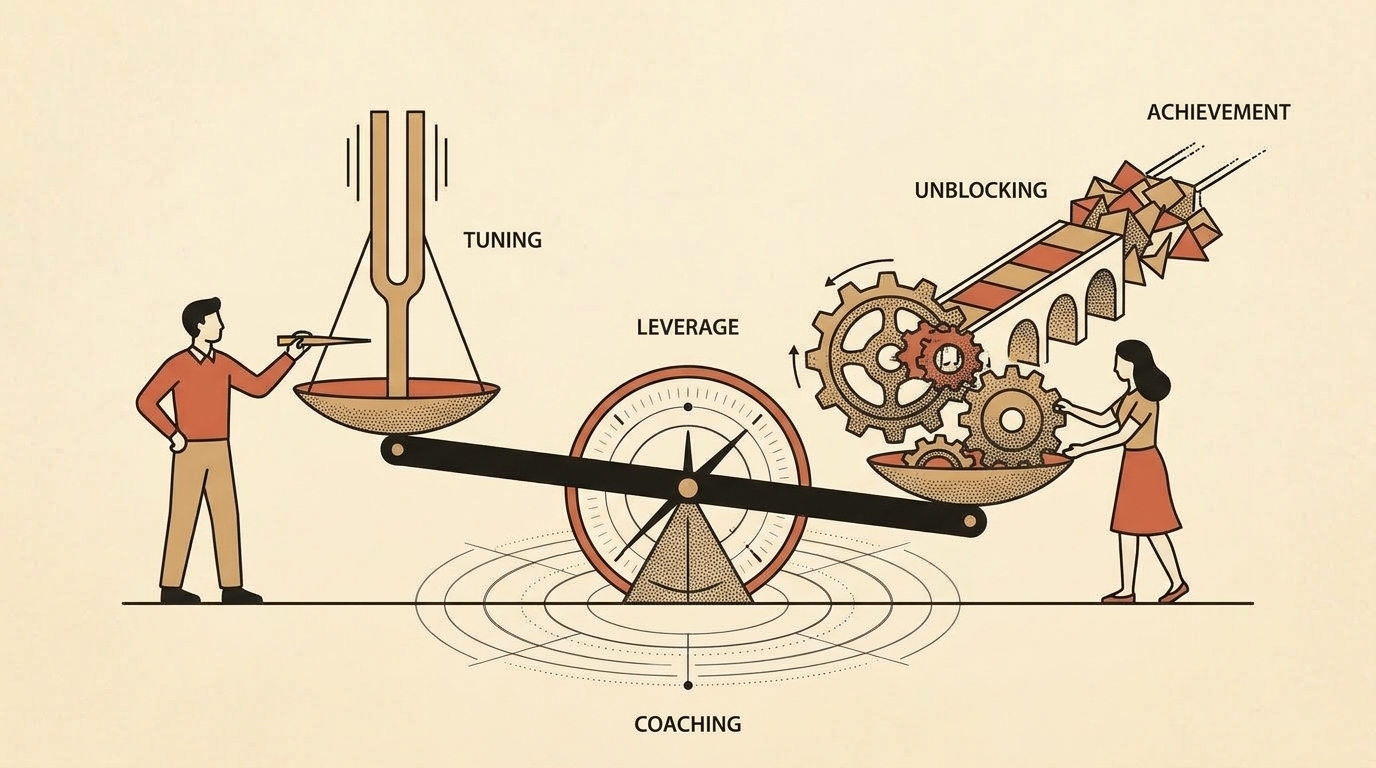
Great management is rarely invented from scratch in a vacuum. The principles that make 1:1 meetings transformative — psychological safety, employee-led agendas, early detection of systemic bottlenecks, and radical candor — have been tested and refined by legendary leaders across decades. Today, we are excited to launch our interactive 1:1 Bookshelf.
Why we built a dedicated 1:1 bookshelf
Most leadership books span hundreds of pages covering corporate strategy, hiring funnels, and organizational politics. Yet when experienced managers look back on what created the highest daily leverage, they almost unanimously point to the chapters on one-on-one meetings.
To help busy engineering leaders tap into these insights without wading through hundreds of pages of theory, we built the interactive 1:1 Bookshelf. We distilled five foundational texts down to their core 1:1 philosophy, key operating principles, concrete questions to ask, and direct pairings with practical templates in our Playbook.
The 5 foundational works
The bookshelf features five seminal titles that shaped modern technical leadership:
- High Output Management by Andy Grove (1983): The foundational classic of Silicon Valley. Grove introduced the revolutionary idea that a manager’s output equals the output of their team, and that 90 minutes of focused 1:1 time enhances 80 hours of subordinate work — an unparalleled >50x time leverage. Crucially, Grove established that the 1:1 is the employee’s meeting.
- The Hard Thing About Hard Things by Ben Horowitz (2014): The definitive guide on crisis leadership. Horowitz positions the 1:1 as the essential organizational safety valve. In high-growth companies, good news travels fast while bad news travels slowly; regular 1:1s are where leaders discover small fires before they become catastrophic emergencies.
- The Making of a Manager by Julie Zhuo (2019): The modern blueprint for empathetic management. Zhuo deconstructs 1:1s into four essential domains: establishing psychological safety, diagnosing real priorities, unblocking difficult challenges, and calibrating long-term ambitions.
- The Manager’s Path by Camille Fournier (2017): The definitive roadmap for engineering leadership. Fournier explores the technical nuances of 1:1s — mentoring junior developers, supporting Staff+ individual contributors, and balancing technical debt with product velocity. She explicitly warns that an engineer claiming "I have nothing to talk about" is a flashing red signal of disengagement.
- Radical Candor by Kim Scott (2017): Combining personal care with direct challenge. Scott frames the 1:1 as the private forge where trust is built. Crucially, she emphasizes asking for critical feedback on your own leadership before handing out critique to others.
From philosophy to real meeting agendas
A leadership book is useless if its lessons stay on paper. For each featured book, the Bookshelf provides battle-tested questions you can immediately use in your next meeting, along with matching Playbook agendas:
- Grove’s leverage methodology pairs directly with our High-Leverage 1:1 Manifesto.
- Horowitz’s organizational health insights connect to our Skip-Level 1:1 Health Check.
- Zhuo’s trust-building practices power our First 1:1: Expectations & Trust template.
- Fournier’s career ladder framework informs our Quarterly Career & Growth Check-in.
- Scott’s feedback and burnout techniques inspire our Overwhelm & Burnout Triage guide.
Putting it into practice with encrypted1on1
The true barrier to high-leverage 1:1s is rarely a lack of good intentions — it is lack of preparation and mutual psychological safety. When meetings are scheduled without a collaborative, confidential space, conversations inevitably collapse into superficial status recaps.
With encrypted1on1, managers and team members can choose proven questions from these classic works, prepare reflections asynchronously, and maintain complete confidence that their candid thoughts are shielded by zero-knowledge end-to-end encryption.
Explore all five books, read the executive summaries, and grab ready-made questions at /playbook/books/.